Choose your own LED driver and light source, or accept whatever a supplier bundles in. When you buy a complete LED downlight from a single supplier, you get what they give you. The driver is their choice. The LED module is their choice. The price is their price. You think the driver is overpriced? You can’t swap it. You think the LED module isn’t good enough? You can’t change it. You know a better supplier? Still can’t switch.
ECO LED Kit Gives You the Housing. You Choose Everything Else.
Our housing kits are designed to be compatible with mainstream brand LED drivers and light sources. You decide which brand, which specification, and which price point goes inside.
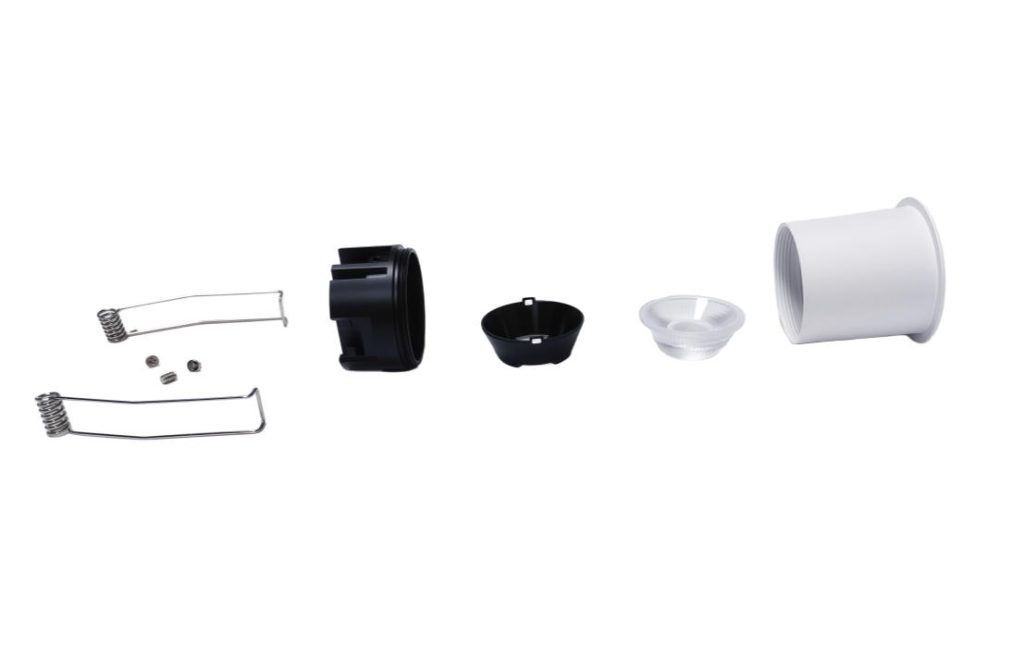
What “compatible” means in practice: the driver compartment is sized for common IP20 constant-current drivers from 12 to 45 millimetres in width, the LED module seat carries standard COB footprints from 16 to 30 millimetres, and the cable channel runs from the driver bay to the module position without a junction. If your chosen driver falls outside that envelope, tell us the datasheet before ordering — we will confirm the fit rather than leave you to discover it on the bench.
Negotiating Power Returns to You
Drivers and LED modules represent the largest cost share in a finished downlight. When these are bundled into a complete lamp, you have zero visibility into the actual component costs and zero leverage to negotiate. When you source them yourself, you bring your own supplier relationships, your own volume leverage, and your own price comparisons to the table.
Put numbers on the negotiation. On a typical 6-inch COB downlight selling at 8 to 12 dollars, the housing accounts for roughly 20 to 25 percent, the driver 25 to 30 percent and the LED module 30 to 35 percent. When those three are bundled, the only number you can argue about is the total. When the housing is quoted separately, you can walk into your driver supplier with a real target: if the driver line is 30 percent of the unit price, a ten percent driver discount moves the total by three percent — and you can see exactly where that three percent came from.
Switching Freedom Returns to You
This order uses Brand A’s driver. Next order, Brand B has a promotion — switch without asking the housing supplier for compatibility confirmation. Different project requires a dimmable driver instead of non-dimmable? Swap it. Your market shifts from 2700K to 4000K? Change the LED module. The housing stays the same.The switch costs you nothing in tooling, because nothing about the housing changes. There is no re-certification of the shell, no new mould, no second SKU for the warehouse. The only thing that moves is the purchase order to your component supplier — and that can move as fast as your next container. That is the whole point of a platform: the expensive, slow part stays fixed while the fast, cheap part keeps improving.
Quality Control Returns to You
You know which driver brands perform well because you’ve used them before. You know which LED modules hold up over time because your customers told you. With a complete lamp, you’re trusting the supplier’s internal supply chain — which you’ve never inspected, never tested, and never compared against alternatives.
Who Controls the Components Controls the Profit
In the LED downlight business, the profit margin is in the components, not the housing. When you let a complete lamp supplier lock in your driver and LED source, you’re giving away the part of the value chain where margins are most negotiable.
Take it back. The housing is a platform. The components are your decision.
ECO LED Kit housing kits do not include drivers or LED modules. Customers source and install their own certified components.
Related reading: change the driver, not the shell.